Invention review
Thermoresponsive mucoadhesive nasal powder for out-of-hospital rescue therapy in acute repetitive seizures
A nasal powder that gels only after it lands claims to fix the drip-out problem in seizure rescue. The ratio window is the interesting part, and it is also the part that will be hardest to defend.
Kandula Mahesh
3 minute read
What the submission claims
The proposal is a dry powder that gels only after it lands. Micronised diazepam is blended with poloxamer 407 and carboxymethyl chitosan, then puffed into the nose from a propellant-free single-use device. Nothing is a gel in the container. Hydration by nasal mucus at body temperature triggers the sol-to-gel transition in situ, which is where the claimed 46-minute residence time comes from.
What I believe is new is the specific poloxamer 407 to carboxymethyl chitosan ratio window, roughly 4:1 to 6:1 by weight, at which the powder both flows well enough to actuate from a propellant-free device and still gels within 20 seconds of hydration.
That is the right claim to lead with, and it is narrower than the covering language in the published application. The rest of this review is mostly about whether the window survives contact with the prior art.
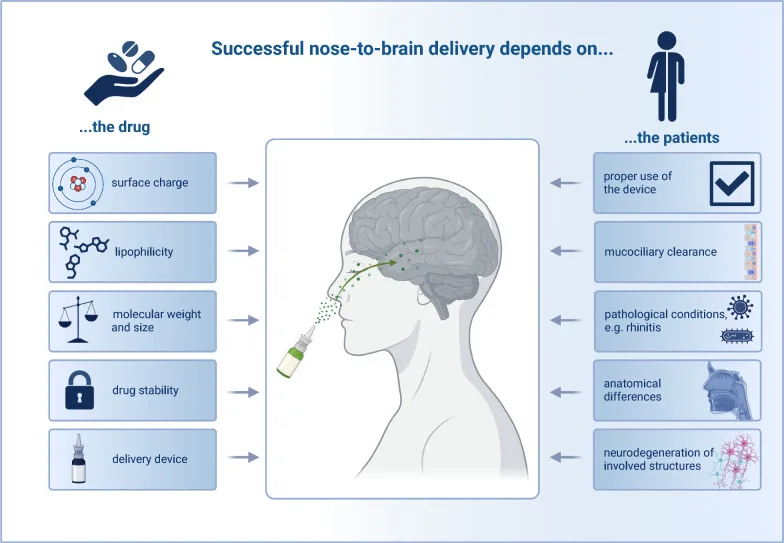
How it compares with what is used today
Format | Pre-Dose Volume | Consolvent | Onset | Storage |
|---|---|---|---|---|
Rectal Gel | 4 ml | none | 10-15 mins | 250C |
Nasal Liquid Spray | 0.1ml per nostril | PEG 300, benzyl alcohol | 5 to 10 mins | 250C |
The cosolvent column is the honest advantage. Benzyl alcohol and PEG 300 are in the approved nasal products because a benzodiazepine will not dissolve in 0.1 mL of water, and they are also why a frightened patient sneezes out part of the dose. 1Removing the solvent by never having one is a real idea, not are formulation.
Poloxamer 407 alone gels near 34 °C at about 18 % w/v, so the polymer is doing the thermal work and the chitosan is doing the sticking. The submission's FTIR trace shows the carboxylate band near 1590 cm-1 shifting on hydration, consistent with COO- groups ion-pairing rather than simply swelling, and the powder is blended under N2 to keep the free acid from picking up water. Whether that also means Ca2+ bridging with mucin, as the application implies, is not shown by this data.
Anton Paar MCR 302, 25 mm parallel plate, 0.5 mm gap
  Oscillation: 1 Hz, 0.5 % strain
  Temperature sweep: 20 to 40 C at 1 C/min
  Gel point: G' = G'' crossover
  n = 6 per ratio, powder hydrated with 40 uL simulated nasal fluid
What would strengthen the case
A human nasal cast study. The sheep model answers residence time but not deposition in the olfactory region, which is what the dose claim depends on.
Actuation force measured across the window, from a carer's hand rather than a rig. A device a panicking parent cannot fire is not a rescue product.
That is from the 2019 review, and it is exactly the trade-off a dry powder sidesteps. 2The question a searcher will ask is whether anyone has already claimed a dry thermo-responsive blend for nasal use, as opposed to a liquid one, and whether the ratio window is a selection invention over that.
References
- ↩
Chen Z, Brodie MJ, Kwan P. Drug-resistant epilepsy: a review of prevalence across treatment eras. Link the
journal name to https://pubmed.ncbi.nlm.nih.gov/?term=drug+resistant+epilepsy+prevalence
- ↩
In situ gelling systems for nasal drug delivery: a review. Link to
https://pubmed.ncbi.nlm.nih.gov/term=in+situ+gelling+nasal+delivery